

Style Guide
The API Style Guide enforces consistent design standards across every specification in your organization. Routebase ships with 58 built-in linting rules that cover naming, completeness, best practices, security and structure, and you can add custom rules on top. Violations surface live in the API Designer and can block publishing.
The Style Guide is available on the Pro plan, and on lower plans the settings page shows an upgrade prompt. Configuring it requires the org:manage-governance permission, which Admins and Owners hold.
Configuring the style guide
Open Settings → Style Guide, which describes itself as "Configure organization-wide style guide rules. These settings apply to all projects unless overridden."
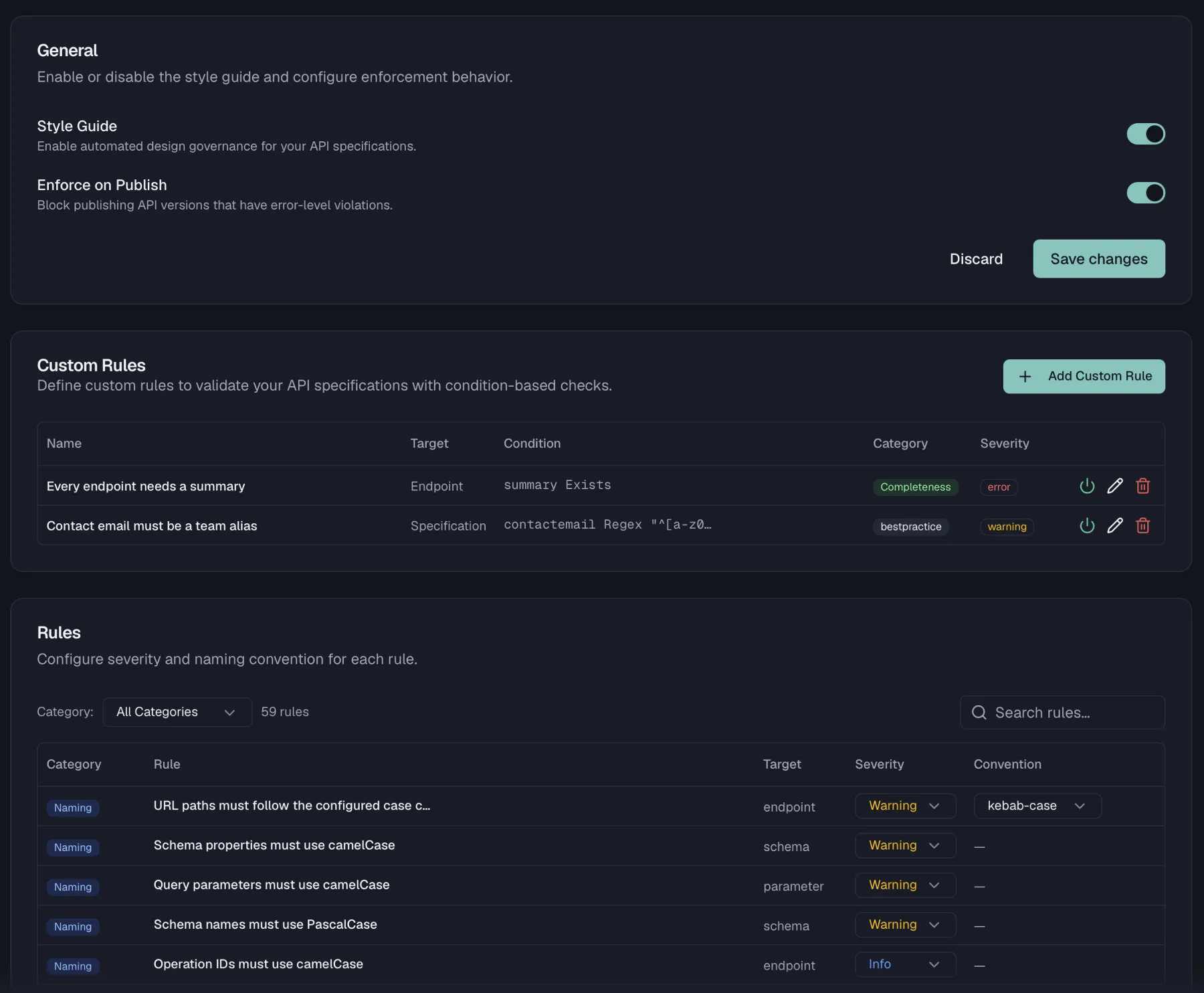
The General card controls enforcement behavior:
| Setting | Description | Default |
|---|---|---|
| Style Guide | Enable automated design governance for your API specifications. | On |
| Enforce on Publish | Block publishing API versions that have error-level violations. | Off |
Click Save Changes to apply (or Reset to discard).
Rules and severities
The Rules card lists every rule with its category badge, name, target, and a severity dropdown. Filter by category, search by name, and page through the list. Each rule's severity can be set to:
| Severity | Effect |
|---|---|
| Error | Blocks publishing when Enforce on Publish is enabled. |
| Warning | Reported, but never blocks. |
| Info | Informational hint. |
| Off | Rule disabled. |
Rules you've changed from their default are marked with an override badge and can be reset to the default with one click. Rules that only apply to OpenAPI 3.0 specs carry a 3.0 only badge, and your own rules carry a custom badge.
Naming conventions
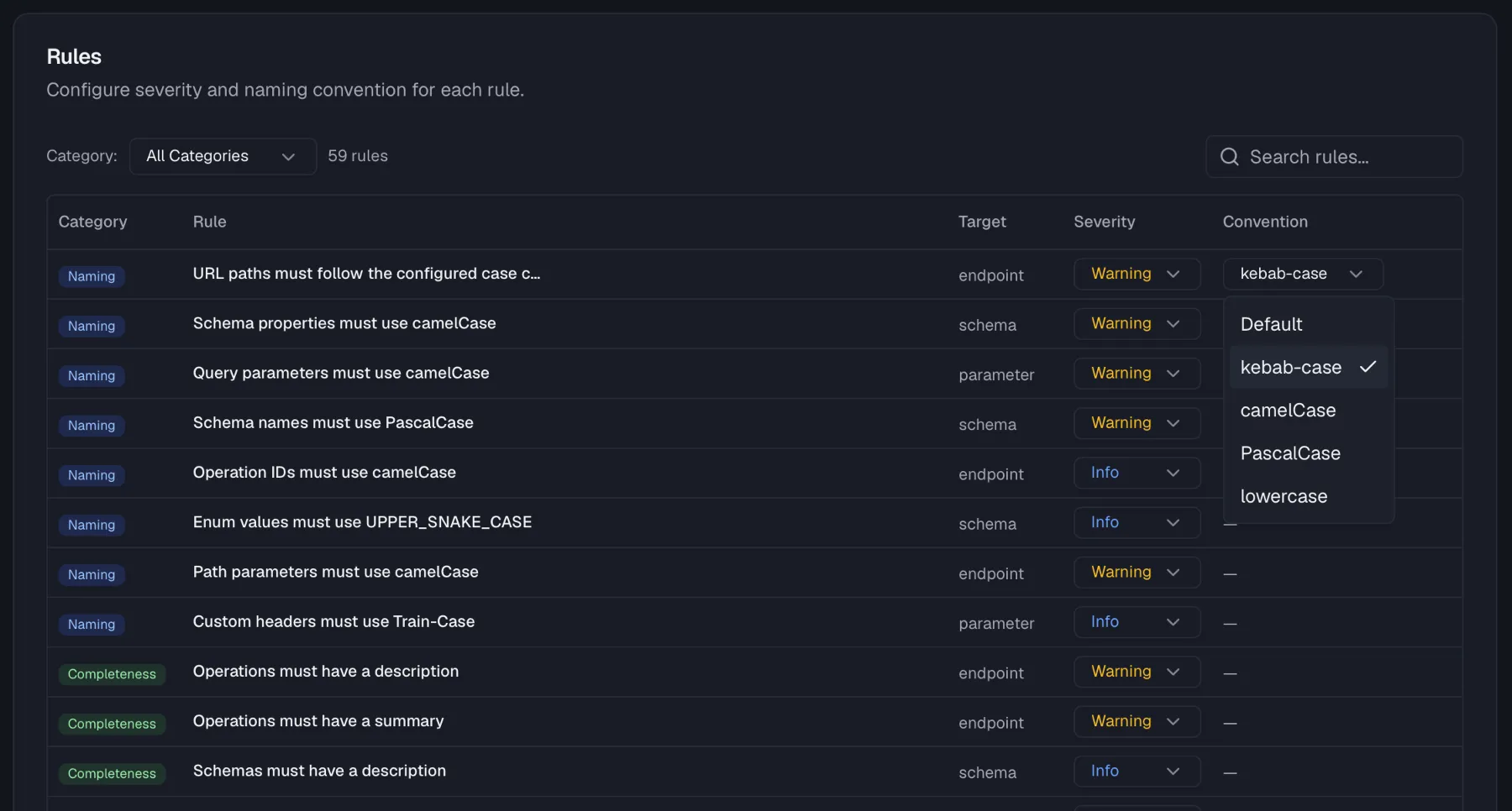
Not every naming rule hard-wires the convention it enforces. Where the convention is configurable, the table shows a Convention column with a dropdown, and the rule checks whatever you pick there.
The rule for URL paths is the one that matters in practice, because it defaults to kebab-case but also accepts camelCase, PascalCase and lowercase. So a team that has always written /userProfiles doesn't have to choose between switching its whole URL scheme and turning the rule off. It sets the convention and keeps the check.
Project-level overrides
Each project can override severities for its own specs, which you do from the project's Style Guide tab. The project view adds a Source column showing where each severity comes from, reading Custom for this project, Org or Default. Overridden rules can be reset back to the organization default.
Built-in rules
Routebase ships 58 built-in rules in five categories. Each rule has a default severity of Error, Warning or Info, which you can change per organization and per project. The tables below list the default.
Rules whose name says "must" are not automatically errors. Severity and wording are set independently, so a rule can be named "must" and default to Warning.
Naming (8)
| Rule | Default | Checks |
|---|---|---|
| Path parameters must use camelCase | Warning | Path parameter names (e.g., {userId}) should use camelCase naming convention. |
| Query parameters must use camelCase | Warning | Query parameter names should use camelCase naming convention. |
| Schema names must use PascalCase | Warning | Schema names should use PascalCase naming convention (e.g., 'UserProfile'). |
| Schema properties must use camelCase | Warning | Object property names in schemas should use camelCase naming convention. |
| URL paths must follow the configured case convention | Warning | Path segments (excluding path parameters) must follow the configured naming convention (default: kebab-case). The convention is configurable. |
| Custom headers must use Train-Case | Info | Custom header parameter names should use Train-Case (e.g., 'X-Request-Id'). |
| Enum values must use UPPER_SNAKE_CASE | Info | String enum values in schemas should use UPPER_SNAKE_CASE naming convention. |
| Operation IDs must use camelCase | Info | Operation IDs should use camelCase naming convention (e.g., 'getUsers'). |
Completeness (10)
| Rule | Default | Checks |
|---|---|---|
| API must have a server URL | Warning | The API specification should define at least one server URL. |
| API must have a version | Warning | The API specification should define a version string. |
| Operations must have a description | Warning | Each endpoint should have a description explaining its purpose and behavior. |
| Operations must have a summary | Warning | Each endpoint should have a brief summary. |
| API must have a license | Info | The API specification should include a license identifier. |
| API must have contact information | Info | The API specification should include a contact email for consumers to reach out. |
| Parameters should have descriptions | Info | Each parameter should have a description explaining its purpose and expected values. |
| Responses must have a description | Info | Each response should have a description explaining what it represents. |
| Schemas must have a description | Info | Each schema should have a description explaining what data it represents. |
| Tags should have descriptions | Info | Each endpoint tag should have a description to document the group's purpose. |
Best practices (20)
| Rule | Default | Checks |
|---|---|---|
| Operation IDs must be unique | Error | Each operation ID must be unique across all endpoints in the specification. |
| Path parameters must be declared | Error | Each {parameter} in the path must have a corresponding parameter definition with 'in: path'. |
| Paths must be unique | Error | Two endpoints on the same method must not address the same route. OpenAPI ignores the name of a path placeholder, so /items/{id} and /items/{itemId} are the same path. |
| Paths must not have empty segments | Error | Paths must not contain double slashes or empty segments (e.g., '/users//profile'). |
| Server URL must match URL-path versioning pattern | Error | When using URL-path versioning, server URLs should include a version prefix (e.g., /v1). |
| Deprecated versions should have a sunset date | Warning | Deprecated API versions should define a sunset date to inform consumers when the version will be removed. |
| Operation IDs must be valid in URLs | Warning | Operation IDs must contain only alphanumeric characters, dots, hyphens, and underscores to be safely used in URLs. |
| Operation tags must be defined | Warning | Tags used on operations must be defined in the specification's global tags list. |
| Paths should not end with a trailing slash | Warning | Paths should not have a trailing slash (e.g., '/users/' should be '/users'). |
| Schema references must resolve | Warning | Every $ref in a schema must point to a schema that exists in this specification. |
| Server URL must not be example.com | Warning | The server URL should be a real API endpoint, not a placeholder like example.com. |
| Success responses should return an object, not a bare array | Warning | Top-level API responses should be JSON objects for extensibility, not bare arrays. |
| Tag names must be unique | Warning | Each tag name must be unique within the specification to avoid ambiguity. |
| Create endpoints should accept an idempotency key | Info | POST endpoints that return 201 Created should accept an Idempotency-Key header so a retried request does not create a second resource. |
| Endpoints should define error responses | Info | Each endpoint should define at least one error response (4xx or 5xx) or a default response. |
| Error responses should use application/problem+json | Info | 4xx and 5xx responses should use the RFC 7807 Problem Details format (application/problem+json). |
| List endpoints should have pagination parameters | Info | GET endpoints that return collections should include pagination query parameters. |
| No unused schema components | Info | Schemas defined in components should be referenced by at least one endpoint or other schema. |
| Published versions should have aliases | Info | Published API versions should have human-readable aliases (e.g., 'v1') for easier consumer adoption. |
| Versioning strategy should be configured | Info | API specifications should have a versioning strategy configured to enable consistent version management. |
Security (10)
| Rule | Default | Checks |
|---|---|---|
| Descriptions must not contain eval() | Error | Description fields must not contain eval() calls which could be exploited for XSS in rendered API documentation. |
| Descriptions must not contain script tags | Error | Description fields must not contain |